

Network
What the internet reaches
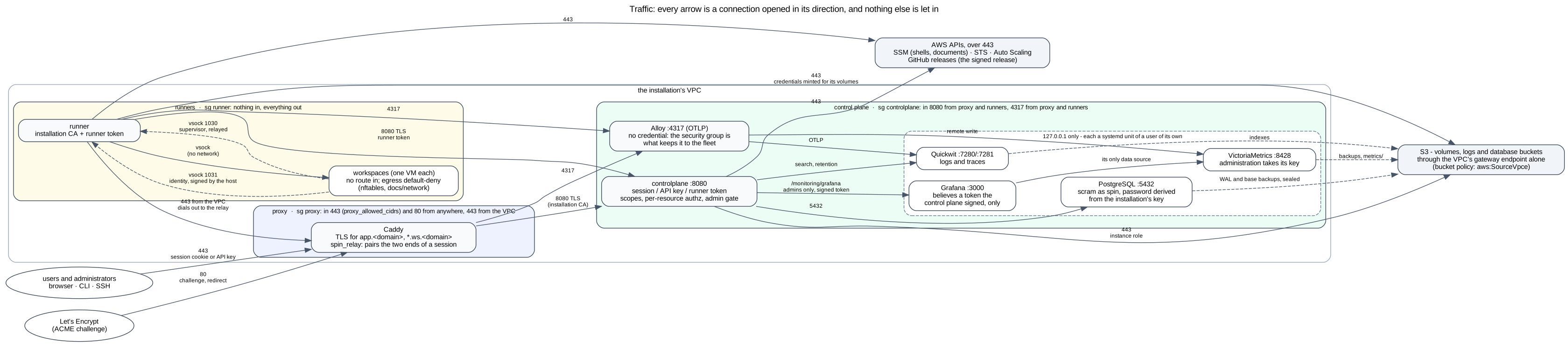
Section titled “What the internet reaches”Only the proxy, on two ports:
| Port | From | For |
|---|---|---|
| 80 | Anywhere | Let’s Encrypt’s challenge, and a redirect to 443 |
| 443 | proxy_allowed_cidrs (anywhere by default) | The dashboard, the API, workspaces’ ports, SSH and terminals |
Nothing else in the installation has an inbound rule for the internet. The control plane’s public address is only a way out. A runner has no inbound rule at all. No machine runs SSH.
Inside the VPC
Section titled “Inside the VPC”| From | To | Port | Who the other end is |
|---|---|---|---|
| Proxy | Control plane | 8080 | TLS under the installation’s CA; the request’s own credential, and for the calls only a proxy makes, the proxy’s token, which it proves again regularly |
| Runners | Control plane | 8080 | TLS under the installation’s CA, and the runner’s token |
| Runners | Proxy (relay) | 443 | The relay’s certificate, and a one-time token per session |
| Proxy, runners | Collector on the control plane | 4317 | Only the security group |
| Control plane, runners | S3 | 443 | Instance roles; the buckets refuse object requests from anywhere but the VPC’s gateway endpoint |
Machines find each other by name in a private zone, spin.internal: cp.spin.internal and
proxy.spin.internal, with a ten-second TTL. Each machine writes its own record when it starts
serving, so a replaced machine is a record changed, not an address in every configuration.
Runners reach the relay inside the VPC, at proxy.spin.internal, so the proxy’s port 443 does
not need to be open to wherever runners are.
Closing the installation to your networks
Section titled “Closing the installation to your networks”Set proxy_allowed_cidrs to the networks your users are on:
proxy_allowed_cidrs = ["203.0.113.0/24", "198.51.100.10/32"]Port 80 stays open to everyone, for Let’s Encrypt.
Why there is no NAT gateway
Section titled “Why there is no NAT gateway”Every machine has a public address in a public subnet, and reaches S3 through the free gateway endpoint. A NAT gateway is billed by the hour in each zone that has one, plus a charge for every gigabyte, before any workspace runs: one alone costs most of what the two machines that run all the time do, and the subnets span several zones. A public address is not an open door: the security groups decide what reaches each machine, and for all but the proxy that is nothing from outside the VPC.
What crossed the network is kept
Section titled “What crossed the network is kept”The VPC’s flow log goes to CloudWatch for 30 days (log_retention_days); flow_logs = false
turns it off, and dns_query_logs = true turns on Route 53 Resolver’s query log. The three are
variables of the control plane’s module, which the root module leaves at their defaults.
A workspace’s own traffic is controlled separately, by its network policies, on the runner. See Network and egress.
Installations run Spinbox v20261027.01; the reference is generated from spin v20261114.01 (51f7e0dea). This page as Markdown, for a model or a terminal.